
Announcements

DeepSeek V3.1 Released: First AI Model with Hybrid Thinking Architecture and Enhanced Agent Capabilities
DeepSeek V3.1 launches with groundbreaking hybrid reasoning architecture, 20-50% improved thinking efficiency, enhanced agent capabilities, and 128K context window. Now available via APIpie.

DeepSeek V3.1 Release

DeepSeek has officially released DeepSeek V3.1, marking a significant step forward in AI model design with the introduction of the world's first hybrid reasoning architecture. This groundbreaking release combines thinking and non-thinking modes in a single model while delivering substantial improvements in agent capabilities and thinking efficiency.

The release represents DeepSeek's vision for the "Agent era" - where AI models are specifically optimized for tool use, multi-step reasoning, and complex workflow automation.

🚀 Key Features of DeepSeek V3.1

Revolutionary Hybrid Reasoning Architecture

DeepSeek V3.1 introduces something unprecedented in the AI space: one model that supports both thinking and non-thinking modes. Users can seamlessly switch between:

  • Non-thinking mode (deepseek-chat) - for fast, direct responses
  • Thinking mode (deepseek-reasoner) - for complex reasoning tasks

This hybrid approach allows users to optimize for either speed or reasoning depth depending on their specific needs, all within a single model architecture.

Dramatically Improved Thinking Efficiency

According to DeepSeek's internal testing, V3.1-Think achieves the same performance as the previous R1-0528 model while using 20-50% fewer output tokens. This improvement translates to:

  • Faster response times for complex reasoning tasks
  • Lower API costs for thinking-intensive applications
  • More efficient token usage without sacrificing quality

The efficiency gains are particularly notable across challenging benchmarks like AIME 2025 (87.5 vs 88.4), GPQA (81 vs 80.1), and liveCodeBench (73.3 vs 74.8), where V3.1 matches R1-0528's performance while being significantly more efficient.

Enhanced Agent Capabilities

DeepSeek V3.1 has been specifically optimized for agent workflows through targeted post-training. The improvements are evident in several key areas:

Programming Agents:

  • Improved performance on SWE-bench (code fixing tasks)
  • Better results on Terminal-Bench (command-line environment tasks)
  • Enhanced multi-file code understanding and debugging

Search Agents:

  • Significant improvements on multi-step reasoning tasks (browsecomp)
  • Better performance on expert-level questions (HLE)
  • Enhanced web browsing and information synthesis capabilities

🔧 Developer-Focused Improvements

Strict Function Calling Support

DeepSeek V3.1's API now includes strict mode for function calling, ensuring that outputs conform exactly to your defined JSON schemas:

# Strict mode ensures perfect schema compliance
response = client.chat.completions.create(
    model="deepseek-chat",
    messages=[{"role": "user", "content": "Get weather data"}],
    tools=[weather_tool],
    tool_choice={"type": "function", "function": {"name": "get_weather", "strict": True}}
)

Anthropic API Compatibility

For developers already using Claude-based applications, DeepSeek V3.1 now supports Anthropic API format, enabling easy integration with existing Claude workflows:

# Drop-in compatibility with Anthropic API format
response = client.messages.create(
    model="deepseek-chat",
    max_tokens=1024,
    messages=[{"role": "user", "content": "Hello!"}]
)

Extended Context Window

Both thinking and non-thinking modes now support a 128K token context window, enabling:

  • Analysis of large codebases
  • Processing of lengthy documents
  • Extended conversation memory for complex workflows

📊 Performance Improvements

According to DeepSeek's benchmarking, V3.1 shows notable improvements in agent-specific tasks:

Programming Tasks:

  • Better performance on SWE-bench (real-world code fixing)
  • Improved Terminal-Bench results (CLI environment tasks)

Search and Reasoning:

  • Enhanced performance on browsecomp (multi-step search reasoning)
  • Better results on HLE (expert-level multi-disciplinary questions)

The model also demonstrates improved output length control in non-thinking mode, producing more concise responses while maintaining quality compared to previous versions.

🔧 Technical Architecture

Model Improvements

  • UE8M0 FP8 Scale parameter precision for improved efficiency
  • Redesigned tokenizer and chat template (incompatible with DeepSeek V3)
  • 840B additional training tokens beyond the base V3 model
  • Post-training optimization specifically for tool usage and agent workflows

Open Source Availability

DeepSeek V3.1 is fully open source and available on multiple platforms:

Base Model:

Chat Model:

🚀 Getting Started with DeepSeek V3.1

Via APIpie's Unified API

DeepSeek V3.1 is available now through APIpie's unified API platform:

import openai

client = openai.OpenAI(
    base_url="https://apipie.ai/v1",
    api_key="your-apipie-key"
)

# Non-thinking mode for fast responses
response = client.chat.completions.create(
    model="deepseek-chat",
    provider="deepseek",
    messages=[{"role": "user", "content": "Explain machine learning"}]
)

# Thinking mode for complex reasoning
response = client.chat.completions.create(
    model="deepseek-reasoner",
    provider="deepseek",
    messages=[{"role": "user", "content": "Solve this complex problem step by step"}]
)

Direct DeepSeek API

You can also access DeepSeek V3.1 directly through DeepSeek's OpenAI-compatible API:

from openai import OpenAI

client = OpenAI(
    api_key="your-deepseek-api-key",
    base_url="https://api.deepseek.com"
)

response = client.chat.completions.create(
    model="deepseek-chat",  # or "deepseek-reasoner"
    messages=[{"role": "user", "content": "Hello!"}]
)

💰 Pricing Updates

DeepSeek has announced pricing changes effective September 6, 2025:

  • New pricing structure will take effect
  • Night-time discount rates will be discontinued
  • Current pricing remains in effect until the transition date

APIpie users benefit from stable, competitive pricing regardless of these changes.

🎯 Who Should Use DeepSeek V3.1

Ideal for Agent Builders

If you're building AI agents that need to:

  • Perform complex coding tasks
  • Handle multi-step search and reasoning
  • Use tools and function calling reliably
  • Process large amounts of context

Perfect for Cost-Conscious Developers

The hybrid architecture means you can:

  • Use fast mode for simple tasks to save costs
  • Switch to thinking mode only when deep reasoning is needed
  • Optimize your token usage without sacrificing capability

Great for Claude Users

With Anthropic API compatibility, you can:

  • Easily migrate existing Claude-based applications
  • Test DeepSeek V3.1 as a drop-in replacement
  • Compare performance without rewriting code

🔮 Looking Forward

DeepSeek V3.1's hybrid architecture represents a significant evolution in AI model design, prioritizing practical utility for real-world applications. The focus on agent capabilities, improved efficiency, and developer experience signals a shift toward more practical, production-ready AI systems.

The open-source availability of both base and chat models also ensures that developers have full access to experiment, fine-tune, and deploy DeepSeek V3.1 according to their specific needs.

🚀 Get Started Today

DeepSeek V3.1 is available now through APIpie's unified API platform. Whether you're building your first AI agent or looking to upgrade existing applications, V3.1's combination of efficiency, capability, and flexibility makes it an compelling choice.

Visit our Dashboard to start experimenting with DeepSeek V3.1 alongside 200+ other AI models, all through one simple API.


Stay updated with the latest AI model releases and capabilities through APIpie - your gateway to the full spectrum of AI models.

Alexander Carrington

Alexander Carrington

GPT-5 Features, API Changes, Integrations, and Benchmarks: The Complete Guide for Power Users and Developers

Discover GPT-5's new features, benchmarks, Gmail & SharePoint integrations, API updates, 256K context window, free-form tool calls, and verbosity control. Learn how it outperforms GPT-4, GPT-4.1, and GPT-4.5.

GPT-5 Features and API Changes

GPT-5 Features, API Changes, Integrations, and Benchmarks: The Complete Guide for Power Users and Developers

The long-awaited GPT-5 has arrived, and it's much more than just a model upgrade. Whether you're a power user of ChatGPT or a developer integrating AI into complex workflows, GPT-5 delivers improvements in accuracy, reasoning, integrations, and developer control that change the game.

This guide covers GPT-5 features, API changes, benchmarks, Gmail and SharePoint integration details, verbosity vs. tokens, free-form tool calls, and clears up the context window size confusion — optimized for both AI enthusiasts and technical teams.

🚀 What's New in GPT-5

OpenAI's GPT-5 introduces a unified architecture that blends fast responses, deep reasoning, and an intelligent router that selects the best strategy for each task. The result is fewer errors, faster performance, and richer answers.

Key GPT-5 Features for All Users

  • Enhanced reasoning in math, coding, science, and multimodal tasks.
  • 65% fewer hallucinations vs GPT-4 models.
  • Safer completions with more natural refusals.
  • Transparent tool use when integrations are active.

Key GPT-5 API Features for Developers

  • 400K token context window with 128K max output tokens - massive capacity for complex tasks.
  • Reasoning token support for enhanced problem-solving capabilities.
  • Predicted outputs feature for faster response generation.
  • Verbosity control for guiding response richness without token micromanagement.
  • Free-form tool calls that return SQL, Python, CLI commands, or custom code formats instead of rigid JSON.
  • Tool call preambles that explain intent before execution.
  • Better tool intent detection for cleaner multi-step agent workflows.
  • MCP (Model Context Protocol) support for advanced integrations.

📊 GPT-5 Benchmarks vs GPT-4, GPT-4.1, and GPT-4.5

Benchmark / CapabilityGPT-4oGPT-4.1GPT-4.5GPT-5 (Thinking Mode)
SWE-bench Verified (Coding)~54.6%~58%74.9%
Aider Polyglot (Multilang Code)~80%~82%~85%88%
GPQA (Science Reasoning)~70.1%71.4%85.7%
HealthBench Hard~30–35%46.2%
Hallucination Rate~11–15%~9%~8%4.8%

Takeaway: GPT-5 consistently outperforms earlier models in reasoning-heavy, coding-intensive, and multilingual contexts.

📧 GPT-5 Gmail, SharePoint, and App Integrations

Power users can now connect GPT-5 to Gmail, Google Calendar, Drive, and SharePoint directly inside ChatGPT's Agent layer. This enables:

  • Inbox summarization
  • Automated email drafting
  • Calendar event planning
  • Document searches

Developers, however, don't get these connectors "for free" in the API. Instead:

  1. Build your own integration with Gmail/SharePoint APIs.
  2. Feed retrieved data to GPT-5.
  3. Optionally define custom tools for automation.

Result: Instant setup for end-users inside ChatGPT, full customization for developers via the GPT-5 API.

📏 Verbosity vs Max Tokens in GPT-5

Many confuse verbosity with max_tokens — but they're different:

  • max_tokens: A hard stop. If reached mid-sentence, the output ends abruptly.
  • Verbosity: A guidance signal.
    • Low = concise, high-signal answers.
    • High = in-depth explanations with examples.
    • Works with max_tokens but reduces the need for huge token limits just to ensure a detailed reply.

For power users, this means more control over answer style. For developers, it simplifies prompt design for output length.

🔧 GPT-5 Free-Form Tool Calls

Earlier OpenAI tool calls required strict JSON outputs, often leading developers to bypass them with prompt-engineered plain text.

With GPT-5:

  • Tools can take raw text arguments (e.g., a SQL query or Python snippet).
  • Outputs are self-contained without conversational fluff.
  • Tool call preambles explain the action before execution.
  • Intent recognition is improved, so GPT-5 uses tools more reliably.

Example: Instead of

{ "query": "SELECT name, age FROM users WHERE active = TRUE;" }

you can receive directly:

SELECT name, age FROM users WHERE active = TRUE;

This is a major win for developers who want clean, parse-ready outputs in agentic workflows.

🧠 GPT-5 Context Window: The Real Numbers

The official specifications confirm GPT-5's impressive capacity:

ModelContext WindowMax Output TokensPricing (per 1M tokens)
GPT-4o128K tokens~16K tokensLower cost
GPT-5400K tokens128K tokens$1.25 input / $10 output

Key Specifications:

  • 400,000 context window - 3x larger than GPT-4o
  • 128,000 max output tokens - enables truly long-form generation
  • October 1, 2024 knowledge cutoff - most recent training data

For long-form generation — books, full-codebase analysis, legal docs — GPT-5 removes the bottlenecks that plagued earlier models.

🎯 GPT-5 Key Takeaways for Power Users

  • More accurate answers with drastically fewer hallucinations.
  • Gmail, Calendar, Drive, and SharePoint integrations inside ChatGPT.
  • Verbosity gives better control over answer detail without abrupt cut-offs.

🔑 GPT-5 Key Takeaways for Developers

  • 400K token context with 128K max output tokens for massive document processing.
  • Free-form tool calls for natural, code-ready outputs.
  • Reasoning token support and verbosity controls for balancing speed and depth.
  • Comprehensive tool ecosystem with web search, code interpreter, and MCP support.
  • Cost optimization through tiered model options (GPT-5, GPT-5 mini, GPT-5 nano).

🚀 Get Started with GPT-5 via APIpie

Ready to integrate GPT-5 into your workflows? APIpie provides seamless access to GPT-5 and other premium models:

  1. Easy Integration: Connect to GPT-5 with a single API endpoint
  2. Cost Control: Monitor usage with our comprehensive dashboard
  3. Developer Tools: Access free-form tool calls and advanced features
  4. Multi-Model Support: Switch between GPT-5, Claude, and other models

Visit our OpenAI Models documentation to get started with GPT-5 today.


Conclusion: GPT-5 isn't just a step up from GPT-4.1 — it's a smarter, more flexible, developer-friendly model. For power users, it means deeper, faster, safer ChatGPT interactions. For developers, it's a toolkit for building next-gen agentic workflows, handling massive datasets, and delivering cleaner automation.


Stay updated with the latest AI model releases and integrations through APIpie. Check out our Dashboard for a real world view on AI.

Alexander Carrington

Alexander Carrington

Claude 4: Next-Gen AI Models with Advanced Coding

Claude 4 models (Opus 4 & Sonnet 4) are now available on APIpie. Experience the world's best coding model, extended thinking with tool use, and enhanced memory capabilities for complex AI agent workflows.

Claude 4

🧠 Anthropic Launches Claude 4

Anthropic has released Claude Opus 4 and Claude Sonnet 4, setting new standards for coding, advanced reasoning, and AI agents. Claude Opus 4 is the world's best coding model with sustained performance on complex tasks, while Claude Sonnet 4 delivers superior coding and reasoning with enhanced precision.

🚀 Key Features of Claude 4

  • World's Best Coding Model (Opus 4)
    72.5% on SWE-bench, 43.2% on Terminal-bench
    → Sustained performance on long-running tasks for hours
    → Thousands of steps with maintained focus and performance
  • Enhanced Everyday Excellence (Sonnet 4)
    72.7% on SWE-bench, significant upgrade from Sonnet 3.7
    → Balanced performance with optimal capability and efficiency
    → Enhanced steerability and instruction following
  • Extended Thinking with Tool Use (Beta)
    → Use web search and tools during reasoning
    → Alternate between thinking and tool use for better results
    → Multi-step workflows with real-time data access
  • Revolutionary Capabilities
    Parallel tool execution for handling multiple tools simultaneously
    Enhanced memory to extract and save key facts across sessions
    65% reduction in shortcuts/loopholes compared to Sonnet 3.7

📡 Performance & Industry Validation

  • Coding Excellence
    SWE-bench Verified: Opus 4 (72.5%), Sonnet 4 (72.7%)
    Terminal-bench: Opus 4 (43.2%) - best performance
    TAU-bench: Superior results on real-world agent scenarios
  • Industry Leaders
    Cursor: State-of-the-art for coding with codebase understanding leap
    GitHub: Powers new coding agent in GitHub Copilot
    Replit: Improved precision for complex multi-file changes
    Rakuten: 7-hour autonomous refactor with sustained performance
  • Advanced Features
    Memory capabilities: Create and maintain memory files
    Tool-enhanced reasoning: Better accuracy through tool use
    ASL-3 safety measures: Higher AI Safety Level protocols

🛠️ Available now — plug in, route smart, and start building see it on our 👉 Dashboard

Learn more: Anthropic Claude 4 Announcement

Alexander Carrington

Alexander Carrington

Phi-4: Microsoft's Small Language Models with Advanced Reasoning

Phi-4 reasoning models from Microsoft are now available on APIpie. Experience powerful small language models with advanced mathematical reasoning, efficient deployment, and cost-effective API access.

Phi-4

🧠 Microsoft Launches Phi-4 Reasoning Models

Microsoft has released Phi-4-reasoning, Phi-4-reasoning-plus, and Phi-4-mini-reasoning — marking a new era for small language models. These 14B and 3.8B parameter models achieve performance comparable to much larger models through advanced reinforcement learning and inference-time scaling.

🚀 Key Features of Phi-4

  • Advanced Reasoning
    → Inference-time scaling for complex multi-step problems
    → Chain-of-thought reasoning with detailed explanations
    → Trained on high-quality reasoning demonstrations
  • Exceptional Efficiency
    Phi-4-reasoning: 14B parameters rivaling much larger models
    Phi-4-mini-reasoning: 3.8B parameters for edge deployment
    → Lower computational costs and faster inference
  • Superior Performance
    → Better than OpenAI o1-mini and DeepSeek-R1-Distill-Llama-70B
    AIME 2025: 78% (Phi-4-reasoning-plus) vs DeepSeek-R1's performance
    → Outperforms models 5x larger on reasoning benchmarks
  • Open Weight Models
    MIT license for maximum deployment flexibility
    → Available on Azure AI Foundry and Hugging Face
    → No licensing fees for commercial use
  • Multiple Variants
    Phi-4-reasoning: Base 14B reasoning model
    Phi-4-reasoning-plus: Enhanced with RL for higher accuracy
    Phi-4-mini-reasoning: Compact 3.8B model for resource-constrained environments

📡 Performance & Benchmarks

  • Mathematical Excellence
    AIME 2024: 75.3% (reasoning), 81.3% (reasoning-plus)
    GPQA Diamond: 65.8% (reasoning), 68.9% (reasoning-plus)
    OmniMath: 76.6% (reasoning), 81.9% (reasoning-plus)
  • Coding Capabilities
    HumanEvalPlus: 92.9% (reasoning), 92.3% (reasoning-plus)
    → Strong performance on programming tasks
    → Effective code generation and debugging
  • General Reasoning
    → Excellent instruction following and alignment
    → Strong performance across diverse problem types
    → Effective multi-step problem decomposition

🛠️ Available now — plug in, route smart, and start building see it on our 👉 Dashboard

Learn more: Microsoft Azure Phi-4 Blog

Alexander Carrington

Alexander Carrington

Qwen-3: Advanced Multimodal AI Model

Qwen-3, Alibaba Cloud's advanced multimodal AI model, is now available on APIpie. Experience enhanced reasoning, superior coding capabilities, and seamless API integration.

Qwen-3

🧠 Alibaba Cloud Launches Qwen-3

Alibaba Cloud has released Qwen-3, an advanced multimodal AI model with enhanced reasoning capabilities, superior coding performance, and comprehensive vision understanding. The model represents a significant advancement in AI technology with improved instruction following and creative problem-solving abilities.

🚀 Key Features of Qwen-3

  • Enhanced Reasoning
    → Advanced logical thinking and problem-solving capabilities
    → Complex multi-step reasoning across various domains
    → Improved accuracy on mathematical and scientific tasks
  • Superior Coding
    → High-quality code generation in multiple programming languages
    → Advanced debugging and code analysis capabilities
    → Strong performance on programming benchmarks
  • Multimodal Excellence
    → Text, vision, and code understanding in one model
    → Advanced image analysis and visual reasoning
    → Comprehensive document and data processing
  • Improved Instruction Following
    → Precise adherence to complex user requirements
    → Better understanding of context and intent
    → Enhanced creative and analytical outputs
  • Long Context Support
    → Extended context windows for comprehensive understanding
    → Better handling of large documents and datasets
    → Improved coherence in long-form content generation

📡 Performance & Capabilities

  • Coding Excellence
    → Superior performance on HumanEval and MBPP benchmarks
    → Advanced code generation and optimization
    → Effective debugging and code analysis
  • Reasoning Tasks
    → Strong results on mathematical and logical problems
    → Advanced scientific reasoning capabilities
    → Excellent performance on complex problem-solving
  • Multimodal Understanding
    → Advanced vision-language comprehension
    → Document analysis and information extraction
    → Image understanding and description generation
  • Multilingual Support
    → Excellent performance across multiple languages
    → Strong cross-lingual understanding and translation
    → Cultural context awareness

🛠️ Available now — plug in, route smart, and start building see it on our 👉 Dashboard

Learn more: Qwen-3 Official Release

Alexander Carrington

Alexander Carrington

OpenAI o3 & o4-mini: Next-Gen Reasoning Models Now on APIpie

OpenAI's new o3 and o4-mini models are now live on APIpie, offering 200K token context windows, advanced reasoning, improved coding and vision capabilities, and industry-leading cost efficiency. Experience next-gen LLM performance and tool use with APIpie's seamless integration.

 GPT-4.1

🚀 Now Live on APIpie.ai: OpenAI o3 + o4-mini

We're excited to roll out OpenAI’s most powerful reasoning models to date — available now through APIpie.ai!

🔥 OpenAI o3

• 200K token context
• Full agentic tool use: Python, file analysis, browsing, image generation
• State-of-the-art reasoning across math, science, code, and visual tasks
• 20% fewer real-world errors than o1

OpenAI o4-mini

• 200K token context
• Optimized for high-throughput, cost-efficient reasoning
• Best performance-to-price model on AIME 2024 & 2025
• Tool-capable, with high-effort variants for complex logic

🧠 What Makes These Models Special

• Trained to reason about when and how to use tools
• Excels in code (SWE-bench, Codeforces), vision (CharXiv, MathVista), science (GPQA)
• Supports complex chains of reasoning + visual understanding
• Safer with reinforced refusal training and new frontier-risk evaluations

🧪 Codex CLI

Terminal-native LLM tool for advanced reasoning workflows.
Pass screenshots, low-res sketches, or code directly to the model.
Open-source now: github.com/openai/codex

Use it with APIpie now by simply changing your ennvironment variables

export OPENAI_BASE_URL="https://apipie.ai/v1"
export OPENAI_API_KEY="your-APIpie-key-here"

🔁 Next Up

• o3-pro coming soon
• Expanded Responses API support for tool calls + reasoning summaries
• Stay tuned for even smarter API routing & live performance benchmarking on APIpie!

Alexander Carrington

Alexander Carrington

OpenAI GPT-4.1: Increased Context & Performance

OpenAI has launched GPT-4.1, featuring a massive 1 million token context window, improved coding capabilities, better instruction following, and 26% lower cost than GPT-4o.

 GPT-4.1

🧠 OpenAI Launches GPT-4.1

OpenAI has officially launched GPT-4.1, its latest flagship language model. This release includes three versions:
GPT-4.1, GPT-4.1 Mini, and GPT-4.1 Nano — each with major improvements in coding, instruction following, and long-context reasoning.

Key Features of GPT-4.1

  • Expanded Context Window
    → Supports up to 1 million tokens
    → Huge leap from GPT-4o's 128K tokens
    → Ideal for processing large datasets and complex reasoning tasks
  • Improved Coding Capabilities
    +21% over GPT-4o, +27% over GPT-4.5 in SWE-Bench
    → More accurate code generation and debugging
  • Enhanced Instruction Following
    → Better adherence to complex prompts
    → Reduced need for clarifications or re-prompts
  • Cost Efficiency
    → Operates at 26% lower cost than GPT-4o
    → More affordable for developers and enterprise use
  • Updated Knowledge Base
    → Trained on data up to June 2024
    → Smarter, more relevant outputs

📡 Availability & Transition

  • API Access Only
    → Available via API for devs and businesses
    → No ChatGPT Plus access (yet)
  • Model Phase-Outs
    → GPT-4 will be removed from ChatGPT by April 30
    → GPT-4.5 preview deprecated by July 14

🛠️ Available now — plug in, route smart, and start building see it on our 👉 Dashboard

Alexander Carrington

Alexander Carrington

Inline CLI: Total API Control Inside the Prompt

APIpie introduces Inline CLI - a breakthrough feature that lets you control everything from model selection to memory, integrity, and real-time search directly within user prompts using simple command syntax.

Inline CLI Feature

💻 Inline CLI — Total API Control Inside the Prompt

Drop in one-liner commands to control everything from model selection to memory, integrity, shaping, and real-time search — right from the user’s prompt.

🧪 Examples:

:deepsearch :becreative :answerwithclaude :setmodel:openai/gpt-4o :setmemoryon

⚙️ Enable via:

"inline_cli": "all" // (default)

🗨️ User Prompt Example:

{ "content": "Summarize today's AI news :deepsearch :setsearchlang:en :setsearchgeo:US" }

✅ Supports:

  • Model switching & state-maintained overrides (multi-tenancy-ready)
  • Search grounding with region/language targeting
  • Prompt shaping (:becreative, :beprecise, etc.)
  • Memory control
  • User state management & more

💡 Just send :help as a user prompt to see inline help
🚫 Disable with: "inline_cli": false

📘 Docs: Inline CLI Reference


🧠 Multi-Tenant Memory + Observability

We now support per-user state, usage tracking, and long-term memory across all requests.

🔧 Just include:

"user": "your_user_id"

🚀 This Unlocks:

  • 🔍 Sub-user usage tracking
  • 💾 Memory tied to user + sub-user
  • 🔐 Persistent CLI settings
  • 📊 Deep observability by user/session

We’re launching one of the most powerful multi-tenant AI backends out there.


🧱 Works Seamlessly with OpenAI-Compatible APIs

Everything above works instantly with your existing OpenAI-based stack using our /v1/chat/completions route.

Real-time web grounding
Inline API controls
Persistent memory
CLI shaping & model overrides


🧪 Try it now: Docs


We’re not just leveling up —
We’re launching a whole new way to AI.

Modular, memory-aware, and real-world grounded — out of the box.
Let’s build the future — smarter, faster, and together.

— Team APIpie ⚙️

Alexander Carrington

Alexander Carrington

Grok 3 & Grok 3 Mini: Models Now Available

APIpie now offers xAI's latest Grok 3 and Grok 3 Mini models - featuring 131K token context windows, optimized performance on structured tasks, and high reasoning capabilities.

Grok 3

🚀 Grok 3 & Grok 3 Mini are now live on APIpie.ai!

Just dropped: the latest flagship models from xAIGrok 3 and Grok 3 Mini, now fully integrated and ready to route via APIpie's unified AI API.

🔥 Grok 3

• Not a "thinking" model
• Optimized for structured tasks and benchmarks like GPQA, LCB, and MMLU-Pro
• Outperforms Grok 3 Mini on high-structure evals
Context window: 131,072 tokens

⚡️ Grok 3 Mini

• High reasoning performance: AIME'25: 83.0, AIME'24: 90.7
• Transparent “thinking” traces included
• Defaults to low reasoning. • Context window: 131,072 tokens

🛠️ Available now — plug in, route smart, and start building see it on our 👉 Dashboard

Alexander Carrington

Alexander Carrington

Internet Search Grounding: Web Data in Any AI Model

APIpie introduces Search Grounding - enabling any AI model to access real-time information from the web without plugins, agents, or browser tools required.

Internet Grounding

🚨 NEW FEATURE DROP — The Future of AI Has Arrived 🔥

Get ready to experience a whole new level of control and power — we’re unleashing Search Grounding, Inline CLI, Multi-Tenancy, and real-time web-aware models across our entire platform.

If you’re building — or even just using — AI, this changes everything.

🌍 Search Grounding Is Now Live

Now ANY model can answer with real-time, verifiable information — no plugins, agents, or browser tools needed.

🔎 Just drop in a live query, and we’ll:

  • Perform high-quality searches across the web
  • Scrape and clean top results
  • Inject live info into the prompt before the model call

✅ Works with GPT-4o, Claude, LLaMA, Mistral — literally every LLM model we support.


⚙️ Enable with a Simple Inline Config:

🛠️ Usage Options

"web_search_options": {
  "search_context_size": "medium"
}

Use:

  • "low" – Light web grounding
  • "medium" – Moderate (~3 results)
  • "high" – Deep (~5 results)

docs\Features\Internetsearch.md 📚 Docs: Search + Scrape API Reference

Alexander Carrington

Alexander Carrington

Dashboard V2: Global AI Operations Center

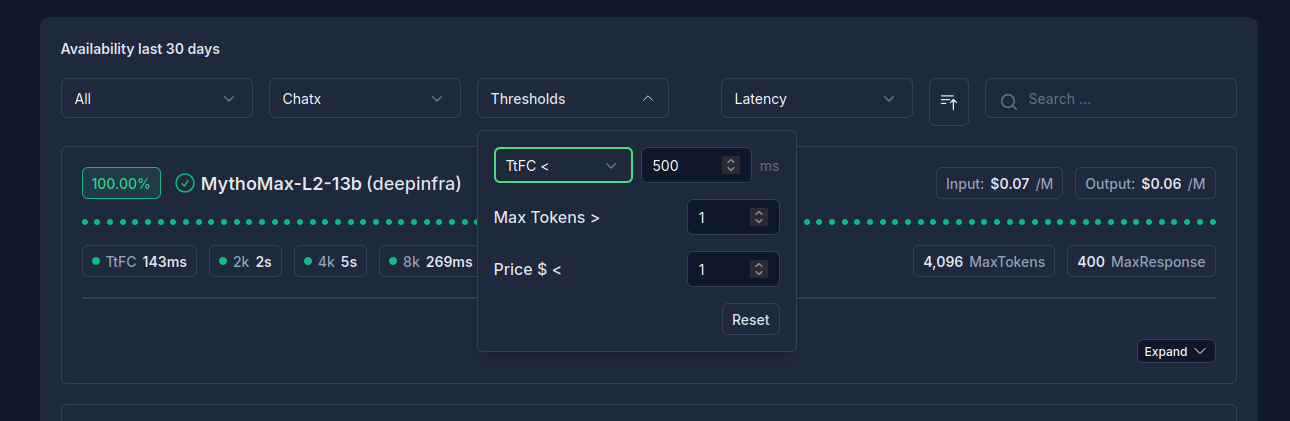
APIpie's Dashboard V2 introduces advanced filtering, sorting, and performance tracking capabilities for AI models, allowing for precise model selection based on type, latency, and pricing.

Dashboard V2

Our Global AI Operations Overview Dashboard just got a serious upgrade — and it's 🔥.

We’ve already been grouping similar models into expandable clusters so you can easily compare them side-by-side, with the top-performing model in each group shown right on the dashboard.
👉 Be sure to click expand to dive deeper and see those comparisons in real-time.

Dashboard V2

🔍 Now You Can Filter and Sort with Depth

✅ Filter Options:

  • Model Types: LLMs, voice, embeddings, and more.
  • Subtypes: multimodal, ChatX, pools, and other custom classifications.
  • Latency Thresholds:
    Exclude models with high latency — by prompt size or TTFC (Time To First Chunk/Token).
  • Price Per Million Tokens:
    Stay in budget without sacrificing performance.

📊 Sort Models By:

  • Throughput
  • Latency
  • Newest
  • Context size
  • Pricing
    ➡️ In ascending or descending order

📈 Need Availability Intel?

We’ve got you covered with:

  • 30-day availability tracking
  • Visual latency graphs

And even more features are coming. 👀


💸 Did You Know?

Our pricing reflects real-world costs — calculated using our proprietary algorithm that evaluates the actual cost of service per model, per provider.
Nobody else reports pricing like this.


Stay tuned for more exciting features, fixes, and integrations!

Alexander Carrington

Alexander Carrington

Llama 4: Scout and Maverick Models Now Available

APIpie now offers Meta's latest Llama 4 Scout and Maverick models - featuring massive parameter counts, extended context windows, and performance that rivals or exceeds leading models like GPT-4o and Gemini Flash.

Llama 4

🚨 Big drop: Llama 4 now on APIpie.ai 🚨

We’ve just integrated the latest Llama 4 Scout and Maverick models — blazing-fast, multimodal, and context-stacked.

🎯 What’s New?

🌟 Llama 4 Scout

🔹 109B parameters (16 experts active)
🔹 10M token context window
🔹 Tops Gemma 3, Mistral 3.1, and Gemini Flash-Lite

🚀 Llama 4 Maverick

🔹 400B parameters (128 experts active)
🔹 1M token context
🔹 Beats GPT-4o & Gemini Flash in vision + code
🔹 Matches DeepSeek V3 in reasoning

🧠 Llama 4 Behemoth (coming soon)

🔹 2T parameter distillation beast
🔹 Outperforms GPT-4.5 & Claude Sonnet 3.7 in STEM
🔹 Still cooking...

🛠️ Available now — plug in, route smart, and start building see it on our 👉 Dashboard

Alexander Carrington

Alexander Carrington

Gemini 2.5: Google's Most Intelligent AI Model

Gemini 2.5 models (Pro & Flash) are now available on APIpie. Experience Google's most intelligent thinking models with enhanced reasoning, state-of-the-art coding, and advanced multimodal capabilities.

Gemini 2.5

🧠 Google Launches Gemini 2.5

Google has released Gemini 2.5 Pro and Gemini 2.5 Flash, thinking models that achieve #1 on LMArena leaderboard by significant margin. These models excel at reasoning through complex problems before responding, with state-of-the-art coding performance and advanced multimodal capabilities.

🚀 Key Features of Gemini 2.5

  • Advanced Thinking Models
    → Think through complex problems before responding
    → Enhanced reasoning capabilities with step-by-step analysis
    → State-of-the-art performance across reasoning benchmarks
  • World-Leading Coding
    #1 on WebDev Arena with ELO score of 1415
    → 63.8% on SWE-Bench Verified with custom agent setup
    → Superior performance on programming tasks
  • Gemini 2.5 Pro: Maximum Intelligence
    → Top across all LMArena leaderboards for human preference
    → 18.8% on Humanity's Last Exam without tool use
    → 1 million token context window (2 million coming soon)
  • Gemini 2.5 Flash: Efficient Excellence
    → 20-30% more efficient while improving performance
    → Speed optimized for high-throughput applications
    → Generally available for production deployment
  • Deep Think (Experimental)
    → Enhanced reasoning mode considering multiple hypotheses
    → Impressive scores on 2025 USAMO benchmark
    → 84.0% on MMMU multimodal reasoning

📡 Performance & Capabilities

  • Reasoning Excellence
    → Leading performance on math and science benchmarks
    → State-of-the-art on GPQA and AIME 2025
    → Superior long context and video understanding
  • Advanced Features
    Native audio output with tone control and 24+ languages
    Computer use capabilities through Project Mariner
    Enhanced security against prompt injection attacks
    Live API with audio-visual input processing
  • Multimodal Capabilities
    → Text, audio, images, video, and code repositories
    → Advanced vision-language comprehension
    → Real-time dialogue with emotion detection
  • Developer Experience
    Thought summaries for structured reasoning processes
    Thinking budgets to control token usage and latency
    MCP support for open-source tool integration

🛠️ Available now — plug in, route smart, and start building see it on our 👉 Dashboard

Learn more: Google I/O 2025 Updates

Alexander Carrington

Alexander Carrington

QwQ-32B: Reinforcement Learning Reasoning Model

QwQ-32B, Alibaba Cloud's reinforcement learning reasoning model, is now available on APIpie. Experience advanced mathematical reasoning and coding capabilities with 32B parameters matching larger models.

QwQ-32B

🧠 Alibaba Cloud Launches QwQ-32B

Alibaba Cloud has released QwQ-32B, a reinforcement learning reasoning model that achieves performance comparable to DeepSeek-R1 (671B parameters) while using only 32 billion parameters. This breakthrough demonstrates the power of scaled reinforcement learning for mathematical and coding tasks.

🚀 Key Features of QwQ-32B

  • Reinforcement Learning Powered
    → Trained with outcome-based rewards and accuracy verifiers
    → Multi-stage RL training for math, coding, and general capabilities
    → Cold-start approach with continuous performance improvement
  • Exceptional Efficiency
    32B parameters matching 671B parameter model performance
    → Significantly lower computational requirements
    → Cost-effective deployment and inference
  • Superior Reasoning Capabilities
    → Advanced mathematical problem-solving
    → Strong coding proficiency and code generation
    → Agent functionality with tool use and environmental feedback
  • Open Source Advantage
    Apache 2.0 license for maximum flexibility
    → Available on Hugging Face and ModelScope
    → No licensing fees for commercial deployment
  • Agent Integration
    → Critical thinking while utilizing tools
    → Adapts reasoning based on environmental feedback
    → Foundation for long-horizon reasoning applications

📡 Performance & Benchmarks

  • Mathematical Reasoning
    → State-of-the-art performance on complex math problems
    → Excellent results across various mathematical benchmarks
  • Coding Excellence
    → Superior programming capabilities
    → Advanced code generation and analysis
  • General Problem-Solving
    → Robust performance across diverse reasoning tasks
    → Strong instruction following and alignment

🛠️ Available now — plug in, route smart, and start building see it on our 👉 Dashboard

Learn more: QwQ-32B Official Blog

Alexander Carrington

Alexander Carrington

GPT-4.5: OpenAI's Strongest Model for Chat

GPT-4.5, OpenAI's largest and best model for chat, is now available on APIpie. Experience enhanced world knowledge, improved EQ, reduced hallucinations, and superior creativity through advanced unsupervised learning.

GPT-4.5

🧠 OpenAI Launches GPT-4.5

OpenAI has released GPT-4.5, their largest and best model for chat. This breakthrough in scaling unsupervised learning delivers enhanced world knowledge, improved emotional intelligence, and significantly reduced hallucinations compared to GPT-4o.

🚀 Key Features of GPT-4.5

  • Scaling Unsupervised Learning
    → Advanced world model accuracy and intuition
    → Broader knowledge base through scaled pre-training
    → Enhanced pattern recognition and creative insights
  • Enhanced Emotional Intelligence
    → Greater "EQ" and natural conversation abilities
    → Better understanding of human intent and subtle cues
    → More empathetic and contextually appropriate responses
  • Significantly Reduced Hallucinations
    37.1% hallucination rate vs GPT-4o's 61.8%
    62.5% accuracy on SimpleQA vs GPT-4o's 38.2%
    → Improved factual accuracy across knowledge domains
  • Superior Creativity
    → Enhanced aesthetic intuition and creative problem-solving
    → Better understanding of design and visual appeal
    → Improved writing assistance and content creation
  • Complementary to Reasoning Models
    → Serves as stronger foundation for reasoning agents
    → Works alongside OpenAI o1/o3-mini reasoning models
    → Future models will combine both paradigms

📡 Performance & Capabilities

  • Academic Excellence
    GPQA (Science): 71.4% vs GPT-4o's 53.6%
    AIME '24 (Math): 36.7% vs GPT-4o's 9.3%
    MMMLU (Multilingual): 85.1% vs GPT-4o's 81.5%
    MMMU (Multimodal): 74.4% vs GPT-4o's 69.1%
  • Human Preference
    56.8-63.2% win rate vs GPT-4o across query types
    → Preferred for creative intelligence and professional queries
    → More natural and intuitive interactions
  • Advanced Capabilities
    → Superior help with writing and programming
    → Enhanced practical problem-solving abilities
    → Better aesthetic judgment for design work
    → Improved conversational warmth and empathy
  • Research Preview Status
    → More expensive than GPT-4o due to large scale
    → Long-term availability depends on community feedback
    → Currently lacks multimodal features (Voice Mode, video)

🛠️ Available now — plug in, route smart, and start building see it on our 👉 Dashboard

Learn more: OpenAI GPT-4.5 Introduction

Alexander Carrington

Alexander Carrington

Claude 3.7 Sonnet: Hybrid Reasoning Model Now Live on APIpie

Claude 3.7 Sonnet, Anthropic's most intelligent hybrid reasoning model, is now available on APIpie. Experience near-instant responses or extended step-by-step thinking, state-of-the-art coding performance, and the new Claude Code agentic tool.

Claude 3.7 Sonnet

🚀 Now Live on APIpie.ai: Claude 3.7 Sonnet

We're thrilled to announce that Anthropic's most intelligent model to date — Claude 3.7 Sonnet — is now available through APIpie.ai!

🧠 Claude 3.7 Sonnet: The First Hybrid Reasoning Model

Dual-mode operation: Near-instant responses OR extended step-by-step thinking
Fine-grained control: Set thinking token budgets up to 128K tokens via API
State-of-the-art coding: Best-in-class performance on SWE-bench Verified and TAU-bench
Real-world focus: Optimized for practical business tasks, not just competition problems

Key Capabilities

Superior coding performance: Exceptional at handling complex codebases and full-stack development
Extended thinking mode: Visible step-by-step reasoning for complex problems
Multimodal excellence: Advanced capabilities across text, code, and visual tasks
Reduced refusals: 45% fewer unnecessary rejections compared to predecessors

🛠️ Claude Code: Agentic Development Tool

Active collaboration: Search, read, edit, test, and commit code autonomously
GitHub integration: Direct repository connections for seamless workflow
Command line native: Terminal-based tool for advanced development tasks
Test-driven development: Complete complex refactoring tasks in single passes

🎯 What Makes Claude 3.7 Special

Unified architecture: Single model that adapts from quick responses to deep reasoning
Industry validation: Preferred by Cursor, Cognition, Vercel, Replit, and Canva
Production-ready: Superior design taste and drastically reduced errors
Flexible reasoning: Trade off speed and cost for answer quality as needed

💰 Pricing

Same cost as predecessors: $3 per million input tokens, $15 per million output tokens
Thinking tokens included: No additional cost for extended reasoning mode
Cost-effective: Pay only for the thinking depth you need

📊 Benchmark Performance

SWE-bench Verified: State-of-the-art performance on real-world software issues
TAU-bench: Leading results on complex real-world tasks with tool interactions
Coding excellence: Validated by top development platforms and frameworks
Instruction following: Superior performance across general reasoning tasks

🔄 Extended Thinking Mode

Visible reasoning: Watch Claude think through complex problems step-by-step
Controllable depth: Set maximum thinking tokens for optimal cost/quality balance
Enhanced accuracy: Significant improvements in math, physics, and coding tasks
Self-reflection: Model evaluates its own reasoning before providing answers

🛡️ Safety & Reliability

Extensive testing: Evaluated by external security and safety experts
Responsible scaling: Comprehensive system card with detailed safety evaluations
Prompt injection resistance: Enhanced training to resist and mitigate attacks
Nuanced understanding: Better distinction between harmful and benign requests

🔁 Next Up

• Enhanced Claude Code capabilities with improved tool call reliability
• Long-running command support and better in-app rendering
• Expanded reasoning model features and performance optimizations
• Stay tuned for continued improvements to the APIpie integration!


Ready to experience the future of AI reasoning? Get started with Claude 3.7 Sonnet on APIpie today and discover how hybrid reasoning can transform your development workflow.

Alexander Carrington

Alexander Carrington

Meet Integrated Model Memory: Cross-Model Caching

Introducing Integrated Model Memory (IMM): A powerful, plug-and-play memory solution that seamlessly integrates across all supported AI models. Enable persistent memory across sessions and models with just a simple parameter.

New Feature

Introducing Integrated Model Memory (IMM) - Now in Beta! 🧠✨

We're excited to announce Integrated Model Memory (IMM) – a powerful, plug-and-play memory solution that seamlessly integrates across all supported AI models! With just a simple parameter, developers can now enable persistent memory across sessions and models, eliminating the need for complex memory management.

Key Benefits

  • ✅ Works across 300+ models
  • ✅ No extra setup—just enable memory!
  • ✅ Persistent context retention across conversations
  • ✅ Multi-user session support

Quick Start Guide

What is IMM?

IMM is our implementation of Cache Augmented Generation (CAG), but unlike traditional CAG systems, IMM works across all models! You can start a conversation with GPT-4, switch to Claude, and finish with Mistral, all while maintaining full context.

Key Features

  • Easy Implementation – Just add "memory": 1 to your API calls!
  • Advanced Session Management – Isolated memory for different users or use cases
  • Smart Memory Controls – Set expiration times, manage memory efficiently
  • Cross-Model Context Retention – Seamless transition between AI models
  • Developer-Friendly – No vector DB needed, fully managed memory

IMM remembers your past conversations—no need to re-send context!

Cross-Model Memory in Action

  1. Start with GPT-4
  2. Continue with Claude
  3. Switch to Mistral

Your conversation context remains intact across all models! IMM ensures full session continuity even when switching providers.

Beta Now Live – Help Us Improve!

Please report bugs so we can refine and improve IMM.

Happy building,

The APIpie Team 🎉

Shawn Gregg

Shawn Gregg

Smart Dashboard Grouping: Compare LMMs at a Glance

APIpie introduces Smart Grouping on the Dashboard: Now compare AI models across different providers with detailed metrics on cost, latency, and availability at a glance. Find the perfect model for your needs faster than ever.

New Feature

📢 New Smart Grouping on the Dashboard! 🔥

We've rolled out a new smart grouping feature on the Dashboard to make your experience even smoother and more efficient! 🚀

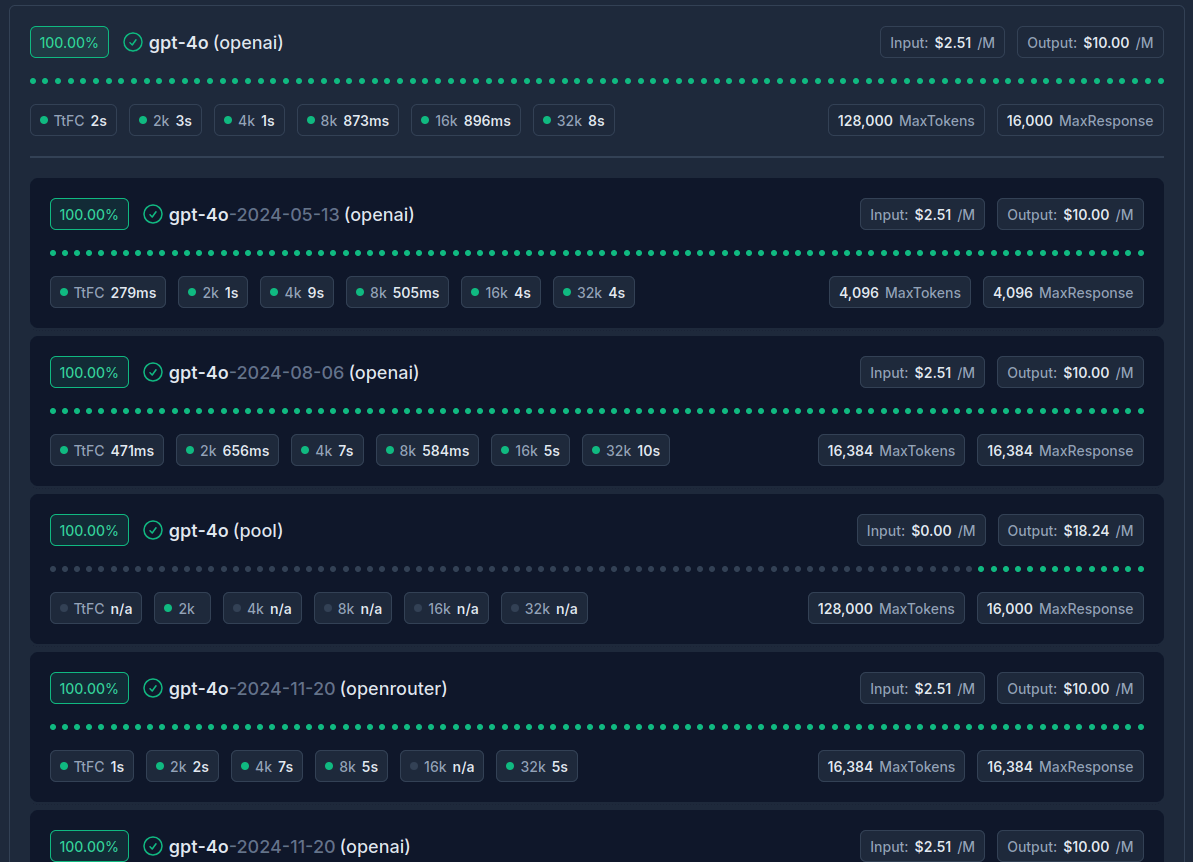
Now, all similar models are grouped together for quick and easy comparison. This means you can effortlessly see how pricing and latency vary across different providers and model variations at a glance. 👀

For example, as you see in the screenshot, all the GPT-4o models are neatly grouped, with model variation specific text differentiated from the base model name. We provide a great side by side comparison in a way you currently can't find elsewhere. We have availability stats, the actual real cost per million tokens captured using real cost analytics and have average latency by prompt/response size, and the "time to first chunk" to ensure the best experience for streaming chat.

Key Benefits

✅ Quickly compare performance and cost between providers and model variations
✅ See real-world cost analytics rather than advertised prices
✅ Compare latency metrics including "time to first chunk" for streaming
✅ Check availability stats to ensure reliable access
✅ Make informed decisions based on comprehensive metrics

Dashboard Grouping

We also have some more exciting features coming soon, a waterfall of new and innovative stuff coming soon.

Stay tuned for updates!

The APIpie Team 🥧

Shawn Gregg

Shawn Gregg

Updates: Reporting, Real-Time Pricing & More

APIpie rolls out significant platform improvements including enhanced model reporting, real-time price tracking based on actual usage, UI/SEO optimizations, and performance fixes to deliver a better developer experience.

Platform Improvements

📢 Update Announcement 📢

We've rolled out several improvements and fixes to streamline functionality, enhance reporting, and improve the user experience.

✅ Model Reporting Updates

  • Image models and models with special characters now report latency properly
  • Coding models are now being actively tested for availability and latency metrics

⚙️ Real-Time Price Reporting

We now provide real-time input/output cost reporting based on actual queries and real provider charges. This gives you the most precise breakdown of model usage costs.

Example (models route):

{
  "enabled": 1,
  "available": 1,
  "type": "llm",
  "subtype": null,
  "provider": "bedrock",
  "id": "titan-text-premier-v1",
  "model": "titan-text-premier-v1",
  "route": "amazon.titan-text-premier-v1:0",
  "description": null,
  "max_tokens": 32000,
  "max_response_tokens": 32000,
  "latency": "7022/8810/395/na/na/5409",
  "query_count": 56,
  "img_price": null,
  "img_json": null,
  "avg_cost": 0.0002729346,
  "price_type": "token",
  "input_cost": 1.00123355,
  "output_cost": 1.49994697
}

Details:

  • input_cost and output_cost reflect real costs per million tokens (e.g., $1 per million input tokens, $1.50 per million output tokens)
  • If no specific cost data is available, the avg_cost column provides an average cost per 1000 characters—useful but less precise

🌐 UI and SEO Improvements

  • Fixed the Robots file to improve web crawler behavior
  • Created a SiteMap for both the root site and documentation
  • Added Meta Tags to the root site
  • Implemented OG Schema & OG Image Generator to generate rich previews when sharing links
  • Included missing Meta Tags to ensure better indexing

🐞 Bug Fixes

  • Resolved an issue causing slow load times on the User Interface

Thanks for your continued support!

The APIpie Team 🥧

Shawn Gregg

Shawn Gregg

Enhanced Error Handling, & Diagnostics

APIpie introduces an enhanced error handling system with clearer messages, better categorization, and improved diagnostics to help developers quickly identify and resolve issues when working with our API.

Improved Error Handling

Improved Error Handling System 🛠️

We're excited to announce significant improvements to our error handling system! These enhancements deliver clearer diagnostics and a more developer-friendly experience when troubleshooting API issues.

What's New

🔍 More Detailed Error Messages

  • Error responses now include specific details about what went wrong
  • Clear suggestions for how to resolve common issues
  • References to relevant documentation where applicable

📊 Better Error Categorization

  • Consistent HTTP status codes aligned with RESTful best practices
  • Logical grouping of errors by type (authentication, validation, rate limits, etc.)
  • Standardized error formats across all endpoints

🚦 Improved Error Transparency

  • Clear distinction between user errors and system issues
  • Better visibility into rate limiting with headers showing remaining quota
  • More predictable error behavior for easier integration

Example Response

Here's an example of our new error response format:

{
  "error": {
    "code": "rate_limit_exceeded",
    "message": "You have exceeded your current quota, please check your plan and billing details.",
    "param": null,
    "type": "quota",
    "details": {
      "limit": 60,
      "remaining": 0,
      "reset": 1703012488
    },
    "documentation_url": "https://apipie.ai/docs/"
  }
}

Benefits for Developers

  • Faster Debugging: Pinpoint issues more quickly with specific error details
  • Easier Integration: Consistent error formats make error handling more predictable
  • Better User Experience: Provide more informative feedback to your end users
  • Reduced Support Needs: Clearer error messages mean fewer support tickets

Implementation Details

This update has been applied across all API endpoints and services. No changes to your integration are required to benefit from these improvements.

We're committed to continuously enhancing the developer experience, and these error handling improvements represent an important step toward making our API more robust and user-friendly.

As always, we welcome your feedback on these changes!

The APIpie Team 🥧

Shawn Gregg

Shawn Gregg

New Billing System: Auto Top-Up & More

APIpie launches a completely rebuilt billing backend with automatic top-up functionality, email verification fixes, and improved payment processing to ensure continuous service for all users.

New Billing System

Completely Rebuilt Billing System 💳

Big news: we've completely rebuilt our billing backend! 🎉

What's New

Email Mismatch & Other Billing Fixes ✅

No more mix-ups with email addresses. Everything now matches perfectly!

Auto Top-Up 🚀

Your credits can now be topped up automatically, so you'll always have enough to keep things running smoothly.

If you spot any issues with payments 💸, just give us a shout and we'll sort it out ASAP.

Additional Improvements

This release also includes a number of other small UI bug fixes and improvements that have been pushed out along with this update.


It's been a long time coming and hopefully we've caught all the potential issues in our QA. If you encounter anything unusual, either raise it here or ping me directly and we will get on it.

Thanks for sticking with us, and have an awesome day! 😄

Cheers,

The APIpie Team 🥧

Alexander Carrington

Alexander Carrington