Understanding Fine-Tuning vs RAG: Whats best?

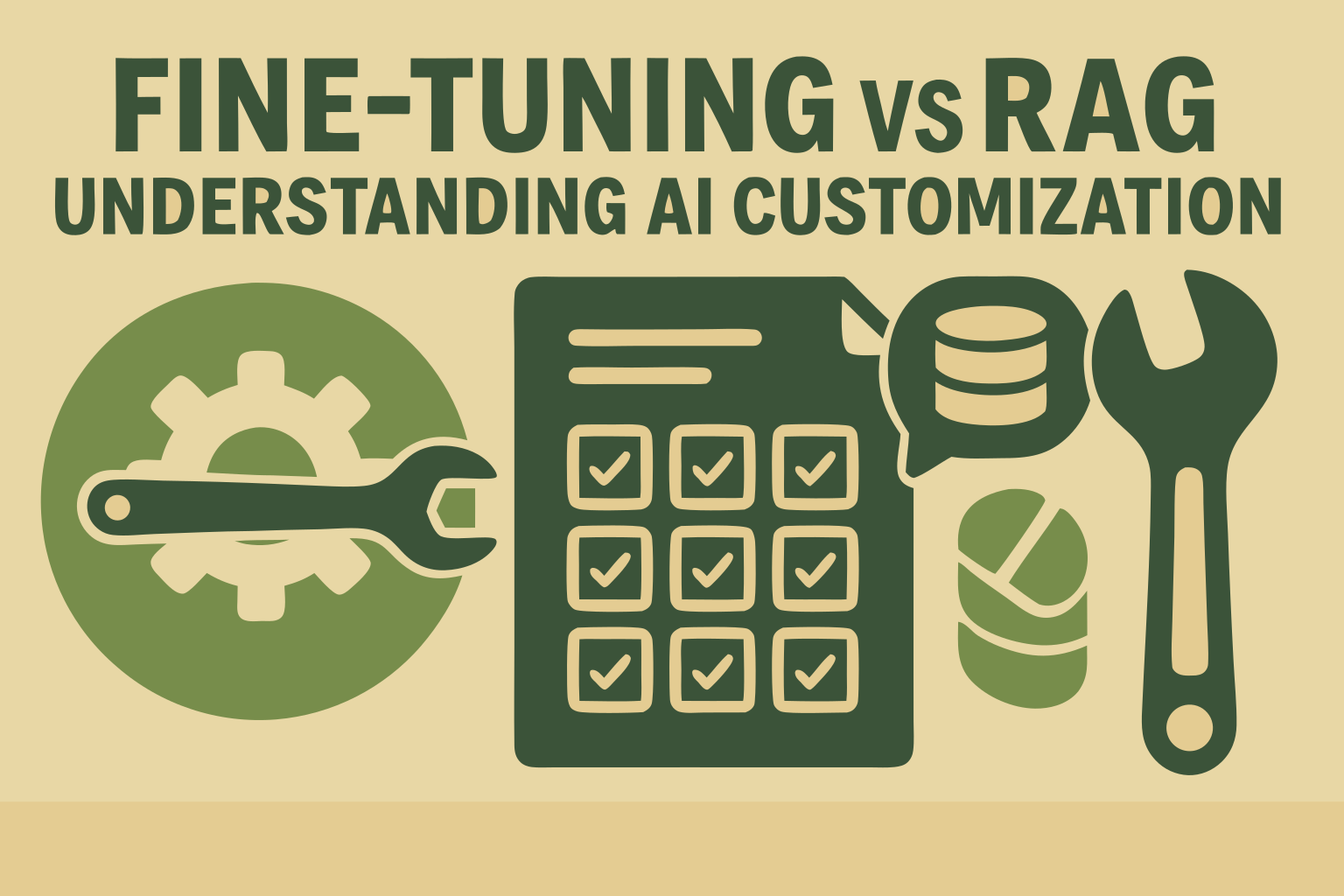
When it comes to customizing AI models for your specific needs, you're faced with a critical decision: should you fine-tune the model itself, or implement a Retrieval Augmented Generation (RAG) system? This choice can significantly impact your project's success, affecting everything from performance and cost to maintenance requirements and scalability. In this comprehensive guide, we'll compare these two powerful approaches to help you make the right decision for your unique use case.
What is Fine-Tuning vs. RAG?
At their core, both fine-tuning and RAG are methods to customize AI behavior, but they take fundamentally different approaches.
Fine-Tuning involves adapting a pre-trained model by:
- Further training it on your specific data
- Modifying the model's internal weights and parameters
- Creating a customized version of the original model
Think of fine-tuning as teaching a general-purpose doctor to become a specialized surgeon—the fundamental knowledge is enhanced with specialized expertise.
Retrieval Augmented Generation (RAG), on the other hand, is like giving an AI model access to a specialized reference library. It involves:
- Keeping the original model unchanged
- Creating a knowledge base of your documents
- Retrieving relevant information at query time
- Augmenting the AI's prompt with this retrieved context
If fine-tuning is training a specialized surgeon, RAG is giving a general doctor instant access to specialized medical textbooks exactly when needed.
For a deeper dive into RAG, check out our detailed guide on Understanding RAG: Retrieval Augmented Generation.
Why the Choice Matters
The decision between fine-tuning and RAG isn't just a technical one—it has significant business implications:
Cost Implications
- Fine-Tuning: Higher upfront costs for training, potentially lower per-query costs
- RAG: Lower setup costs, ongoing storage and retrieval costs
Performance Considerations
- Fine-Tuning: Can achieve higher precision for specific tasks
- RAG: More flexible, handles new information without retraining
Maintenance Requirements
- Fine-Tuning: Requires periodic retraining as information changes
- RAG: Easier to update by simply modifying the knowledge base
Development Complexity
- Fine-Tuning: Requires ML expertise and training infrastructure
- RAG: Focuses more on data preparation and retrieval engineering
According to Stanford's study on LLM customization methods, organizations should carefully evaluate these factors based on their specific use case rather than following a one-size-fits-all approach.
How Fine-Tuning Works
Fine-tuning modifies the model itself through additional training. Here's the process:
1. Data Preparation
First, you need to prepare a dataset that represents the specific knowledge or behavior you want the model to learn:
- Collect examples of inputs and desired outputs
- Format them according to the model's requirements
- Ensure data quality and representativeness
- Split into training and evaluation sets
2. Training Process
The actual fine-tuning process involves:
- Loading a pre-trained model as the starting point
- Setting appropriate learning rates and parameters
- Running additional training epochs on your custom data
- Monitoring for overfitting and other training issues
3. Evaluation and Deployment
After training:
- Evaluate the model on held-out test data
- Compare performance metrics to the original model
- Deploy the fine-tuned model to your production environment
- Set up monitoring for ongoing performance
Fine-tuning is particularly powerful when you need the model to internalize specific patterns, styles, or domain knowledge that would be difficult to capture through prompting alone.
How RAG Works
RAG keeps the model unchanged but augments its input with relevant retrieved information:
1. Knowledge Base Creation
First, you build a searchable knowledge repository:
- Gather your documents, data, and knowledge sources
- Process and chunk them into manageable pieces
- Generate vector embeddings for each chunk
- Store these in a vector database like Pinecone
2. Retrieval Process
When a user query comes in:
- Convert the query to the same vector space
- Search for the most relevant chunks using similarity metrics
- Retrieve the top matches based on relevance scores
3. Context Augmentation
Before sending to the AI model:
- Combine the original query with retrieved information
- Structure this combined context effectively
- Send the augmented prompt to the unchanged AI model
4. Response Generation
The model then:
- Processes the augmented input
- Generates a response informed by the retrieved context
- Provides an answer grounded in your specific knowledge
For a visual representation of this process, consider this simplified flow:
User Query → Vector Embedding → Similarity Search →
Retrieve Relevant Chunks → Augment Prompt →
Send to LLM → Generate Response
Real-World Example: Customer Support System
Let's see how both approaches would handle implementing an AI-powered customer support system for a software company:
The Fine-Tuning Approach
# Example: Fine-tuning implementation (simplified)
# 1. Prepare training data (pairs of customer questions and ideal answers)
training_data = [
    {"role": "user", "content": "How do I reset my password?"},
    {"role": "assistant", "content": "To reset your password, go to the login page and click 'Forgot Password'. Follow the email instructions to create a new password."},
    # Hundreds more examples...
]

# 2. Fine-tune the model
response = openai.FineTuning.create(
    training_file="file_id_for_training_data",
    model="gpt-3.5-turbo",
    suffix="customer-support-v1"
)

# 3. Use the fine-tuned model
completion = openai.ChatCompletion.create(
    model="ft:gpt-3.5-turbo:customer-support-v1",
    messages=[
        {"role": "user", "content": "I can't log into my account"}
    ]
)
Results:
- The model learns patterns from support interactions
- Responses match company tone and policy
- Limited to knowledge available during training
- Requires retraining to incorporate new products or policies
The RAG Approach
# Example: RAG implementation with APIpie (simplified)
# 1. Query with RAG enabled
def get_support_response(query):
    response = requests.post(
        "https://apipie.ai/v1/chat/completions",
        headers={
            "Authorization": "YOUR_API_KEY",
            "Content-Type": "application/json"
        },
        json={
            "messages": [{"role": "user", "content": query}],
            "model": "gpt-4",
            "rag": 1,
            "rag_collection": "support_documentation",
            "rag_depth": 3
        }
    )
    return response.json()

# 2. Use the system
result = get_support_response("I can't log into my account")
print(result["choices"][0]["message"]["content"])
Results:
- Responses incorporate up-to-date documentation
- New product information is immediately available
- Knowledge base can be updated without model changes
- May require more tokens per query due to context inclusion
Decision Framework: When to Choose Each Approach
To help you decide which approach is right for your use case, we've created this decision flowchart:
Choose Fine-Tuning When:
- Task Specialization: You need the model to excel at a specific task format
- Style Consistency: Consistent tone, format, or brand voice is critical
- Efficiency: You need shorter responses with less context per query
- Predictable Domain: Your knowledge domain changes infrequently
- Training Data: You have many high-quality examples (hundreds to thousands)
- Query Patterns: Similar questions are asked repeatedly
Choose RAG When:
- Knowledge Freshness: Information updates frequently
- Factual Accuracy: Precise, up-to-date information is critical
- Transparent Sourcing: You need to trace responses to source documents
- Diverse Queries: Users ask wide-ranging, unpredictable questions
- Limited Examples: You don't have enough examples for effective fine-tuning
- Scalable Knowledge: Your knowledge base will grow substantially over time
Comparison Table
| Factor | Fine-Tuning | RAG |
|---|---|---|
| Setup Cost | Higher (training) | Lower (indexing) |
| Ongoing Cost | Lower per query | Higher per query |
| Update Ease | Requires retraining | Simple document updates |
| Response Speed | Faster (no retrieval step) | Slightly slower |
| Knowledge Freshness | Fixed at training time | Always current |
| Specialization | High for specific tasks | Flexible across domains |
| Implementation Complexity | ML expertise required | Data engineering focus |
| Scaling with Knowledge | Becomes unwieldy | Scales well |
APIpie's Approach to RAG
At APIpie.ai, we've focused on making RAG implementation as simple and effective as possible with our RAGtune system:
Key Features of APIpie's RAG Implementation
- Seamless Vector Database Integration: Built-in Pinecone integration for efficient vector storage and retrieval
- Automatic Document Processing: Handles chunking, embedding, and storage
- Multi-Model Support: Works with all supported AI models
- Customizable Retrieval: Control relevance thresholds and result counts
- Simple API Interface: Enable RAG with just a few parameters
Implementation Example
# Process documents for your knowledge base
curl -X POST 'https://apipie.ai/v1/process/document' \
-H 'Authorization: YOUR_API_KEY' \
-H 'Content-Type: application/json' \
--data '{
  "collection": "product_documentation",
  "text": "Your document content here...",
  "metadata": {"source": "user_manual", "version": "2.1"}
}'

# Query using RAG
curl -X POST 'https://apipie.ai/v1/chat/completions' \
-H 'Authorization: YOUR_API_KEY' \
-H 'Content-Type: application/json' \
--data '{
  "messages": [{"role": "user", "content": "How do I configure the advanced settings?"}],
  "model": "gpt-4",
  "rag": 1,
  "rag_collection": "product_documentation",
  "rag_depth": 3
}'
Learn more about implementing RAG with APIpie in our comprehensive documentation.
Hybrid Approaches: Getting the Best of Both Worlds
While we've presented fine-tuning and RAG as alternatives, innovative organizations are increasingly combining these approaches:
Sequential Hybrid: Fine-Tune Then RAG
In this approach:
- Fine-tune a model on your core domain knowledge
- Implement RAG for up-to-date or supplementary information
- Use the fine-tuned model as the base for RAG queries
This works well when you have a stable core domain with frequently changing peripheral information.
Selective Hybrid: Task-Based Routing
Another approach is to:
- Implement both fine-tuned models and RAG systems
- Analyze incoming queries to determine their nature
- Route to the appropriate system based on query type
For example, product information queries go to RAG, while troubleshooting follows a fine-tuned approach.
Implementation Considerations
When implementing hybrid approaches:
- Ensure clear boundaries between knowledge domains
- Develop effective routing mechanisms
- Monitor performance to optimize the balance
- Consider the additional complexity in your architecture
Best Practices & Tips
Fine-Tuning Best Practices
Do's:
- Create diverse, high-quality training examples
- Test the fine-tuned model extensively before deployment
- Monitor for drift and performance degradation
- Plan for periodic retraining cycles
Don'ts:
- Don't fine-tune on inconsistent or contradictory examples
- Don't expect the model to learn information not in training data
- Don't fine-tune on sensitive data without proper safeguards
- Don't assume fine-tuning will fix all model limitations
RAG Best Practices
Do's:
- Chunk documents thoughtfully for meaningful retrieval
- Implement relevance thresholds to prevent irrelevant context
- Update your knowledge base regularly
- Use metadata to enhance retrieval precision
Don'ts:
- Don't overwhelm the context window with too many retrieved chunks
- Don't neglect document preprocessing and cleaning
- Don't assume perfect retrieval—implement fallbacks
- Don't store sensitive information without proper access controls
Frequently Asked Questions
How much does fine-tuning typically cost compared to RAG?
Fine-tuning has higher upfront costs (typically $500-$3,000 depending on data size and model), but potentially lower per-query costs. RAG has lower setup costs but slightly higher per-query costs due to the retrieval step and larger context windows.
How often should I retrain my fine-tuned model?
This depends on how quickly your domain changes. For stable domains, quarterly updates may be sufficient. For rapidly evolving fields, monthly retraining might be necessary. Monitor performance metrics to determine optimal retraining frequency.
Can I use RAG with my own fine-tuned model?
Yes! This hybrid approach can be very effective. Use fine-tuning for core capabilities and RAG to supplement with up-to-date information.
How much data do I need for effective fine-tuning?
While it varies by use case, most effective fine-tuning projects use at least 100-1,000 high-quality examples. More complex tasks may require several thousand examples.
Does RAG work with all types of documents?
RAG works best with text-based information that can be meaningfully chunked. It can handle PDFs, Word documents, HTML, and plain text. For images, audio, or video, additional processing steps are needed to extract textual content.
Which approach is better for multilingual applications?
RAG typically handles multilingual scenarios better, as you can include documents in multiple languages in your knowledge base. Fine-tuning for multiple languages requires substantial examples in each language.
Ready to Get Started with Customizing Your AI?
The choice between fine-tuning and RAG isn't always straightforward, but understanding the tradeoffs helps you make an informed decision:
- Fine-tuning excels when you need specialized task performance with consistent style and have stable information.
- RAG shines when information freshness, factual accuracy, and knowledge scalability are priorities.
- Hybrid approaches offer flexibility for complex use cases with varying requirements.
👉 Ready to implement RAG for your organization? Visit APIpie.ai and explore our RAGtune system to get started today.
Whether you choose fine-tuning, RAG, or a hybrid approach, the key is aligning your technical strategy with your specific business needs and use cases. The right choice will help you build AI systems that are not just intelligent, but truly valuable for your organization.
Top 5 AI Coding Models of March 2025
Discover the best AI coding models of 2025, including Claude 3.7, GPT-4o, Google Gemini, Cohere Command R+, and DeepSeek, with detailed performance benchmarks and use case recommendations.
Top 5 Agentic AI Coding Assistants April 2025
Discover the leading agentic AI coding assistants of 2025, including GitHub Copilot Agent, Cline, Cursor, QodoAI, and Devin AI, with detailed comparisons and use case recommendations.