

Understanding RAG (Retrieval Augmented Generation)

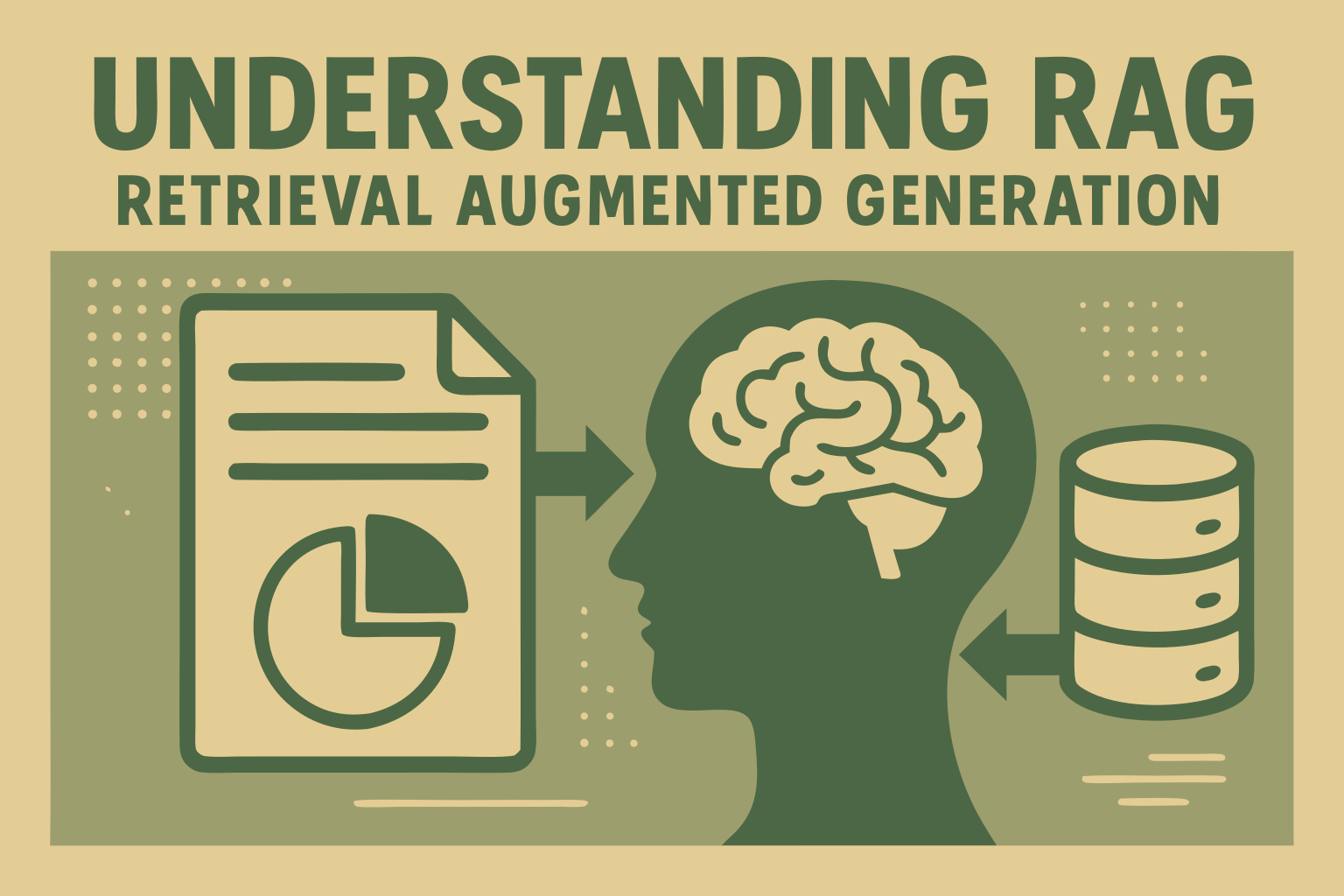
Ever asked ChatGPT a question about a company's latest product, only to get a response about something from 2021? Or wondered why AI sometimes makes up information instead of using your carefully crafted documentation? Enter Retrieval Augmented Generation (RAG) - the game-changing technology that's making AI responses smarter, more accurate, and actually based on your real data.
What is RAG?
Retrieval Augmented Generation (RAG) is like giving your AI a perfect memory and a research assistant. While traditional AI models rely solely on their training data, RAG actively searches through your documents to find relevant information before answering. Here's what that means:
- Retrieval: Think of this as your AI's research phase. Before answering, it searches through your documents to find relevant information.
- Augmented: This means "enhanced" or "improved." The AI takes what it finds and combines it with its existing knowledge.
- Generation: Finally, it creates an answer using both its training and the retrieved information.
How RAG Works: The Building Blocks
RAG's architecture consists of four key layers working together:
1. Database Layer
- Stores all your documents efficiently
- Organizes information for quick access
- Maintains your knowledge base up-to-date
2. Retrieval Layer
- Searches through documents intelligently
- Finds the most relevant information
- Uses advanced matching techniques
3. Augmentation Layer
- Combines AI knowledge with retrieved data
- Enhances responses with specific information
- Ensures accuracy and relevance
4. Network Layer
- Connects all components seamlessly
- Manages data flow between parts
- Optimizes performance
Why Should You Care About RAG?
Imagine having a brilliant but forgetful colleague. They're incredibly smart but sometimes mix up facts or share outdated information. Now imagine giving them instant access to a company's entire knowledge base, allowing them to double-check everything before speaking. That's exactly what RAG does for AI!
RAG combines the creative power of large language models with the accuracy of a custom knowledge retrieval system. Instead of relying solely on what the AI learned during training (which could be outdated or irrelevant to specific needs), RAG lets it pull in specific information from available documents before generating a response. Want to dive deeper into the technical details? Check out the original RAG paper that started it all.
RAG Data Management: Making Information Work
Think of RAG's data handling like a highly efficient library system:
Document Processing
- Accepts various file types (PDFs, docs, spreadsheets)
- Breaks down information into searchable pieces
- Maintains document relationships
Smart Retrieval
- Uses semantic search to understand context
- Finds information based on meaning, not just keywords
- Ranks results by relevance
Data Pipeline
- Processes new documents automatically
- Updates information in real-time
- Maintains data freshness
RAG Components: The Technical Side
Here's what makes RAG work behind the scenes:
Model Architecture
- Embedding system for understanding text
- Vector storage for efficient searching
- Response generation system
Integration Points
- API connections for easy access
- Monitoring tools for performance
- Scaling capabilities for growth
Optimization Features
- Response time improvements
- Accuracy enhancements
- Resource usage management
The "Aha!" Moment That Changes Everything
Think about these frustrating AI moments we've all had:
- "That's not what the product does anymore..."
- "Where did it get that information from?"
- "That's completely made up!"
Here's how RAG fixes these headaches:
- It checks your actual documents before answering
- Always uses the latest information
- Shows you exactly where it got its facts from
- Stays focused on what you actually need to know
How Does RAG Work Its Magic?
Let's break it down:
1. The Library: Your AI's Perfect Memory
Think of this as giving your AI its own research assistant:
- Stores all your important documents
- Handles pretty much any file type you throw at it (check out what we support)
- Keeps everything organized and searchable
- See how we process your documents
2. The Smart Search: Finding What Matters
Remember our Vector Databases blog? Here's where it gets cool:
- Finds information lightning fast
- Understands what you mean, not just what you say
- Connects dots you didn't even know were there
3. The Brain: Putting It All Together
Here's where the magic happens:
- Your question comes in
- RAG finds the perfect pieces of information
- The AI crafts a response that's both smart AND accurate
See RAG in Action: Real-World Magic
Making Customer Support Actually Helpful
Before RAG:
Customer: "How do I use the new feature you launched yesterday?"
AI: "I don't have information about features launched after my training date."
After RAG:
Customer: "How do I use the new feature you launched yesterday?"
AI: "The new Quick Export feature can be accessed by clicking the toolbar icon. Here's a step-by-step guide..." (Based on the latest documentation)
Supercharging Your Research
- Blast through thousands of documents in seconds with our turbocharged search
- Get insights that actually make sense using smart retrieval
- Connect information in ways humans might miss with semantic search
Creating Content That Hits the Mark
- Keep your brand's unique voice with custom settings
- Never worry about accuracy with fact-checking built in
- Stay on-brand with smart content filters
What's In It For Your Business?
1. Save Time (and Money!)
- Cut training time in half
- Let AI handle the repetitive stuff
- Get more value from what you already have
2. Finally, Accuracy You Can Trust
- Say goodbye to outdated info
- Get answers based on your actual data
- See exactly where every fact comes from
3. Scale Without the Headaches
- Make your docs work harder for you
- Keep everyone on the same page
- Update once, update everywhere
The Secret Recipe for RAG Success
1. Quality Matters
- Keep your docs organized (your future self will thank you)
- Update regularly
- Make everything clear and consistent
2. Smart Searching
- Fine-tune your search with our handy guide
- Get the perfect balance of speed and accuracy with hybrid search
- Follow the pros with these tried-and-true tips
3. Smooth Integration
- Pick the right AI for the job
- Keep an eye on performance
- Stay ready for updates
Ready to Jump In?
Not sure where to start? No worries! Check out our features or see how others are making RAG work for them.
Here's how quick it is to get started with APIpie.ai:
# Upload your docs to a RAG collection
curl -L -X POST 'https://apipie.ai/ragtune' \
-H 'Content-Type: application/json' \
-H 'Accept: application/json' \
-H 'Authorization: <API_KEY_VALUE>' \
--data-raw '{
  "collection": "my-ragtune-collection",
  "url": "https://example.com/mydocument.pdf",
  "metatag": "important-document"
}'

# Let RAG do its thing
curl -L -X POST 'https://apipie.ai/v1/chat/completions' \
-H 'Content-Type: application/json' \
-H 'Accept: application/json' \
-H 'Authorization: Bearer <TOKEN>' \
--data-raw '{
  "messages": [
    {
      "role": "user",
      "content": "Your question here"
    }
  ],
  "model": "gpt-3.5-turbo",
  "provider": "openai",
  "rag_tune": "my-ragtune-collection"
}'
What's Next for RAG?
The future's looking bright! More businesses are discovering how RAG helps them:
- Give spot-on answers every time
- Scale their knowledge like never before
- Keep their AI responses in check
- Make their customers happier than ever
Want to Make Your AI Smarter?
Tired of your AI making things up or giving outdated answers? With APIpie.ai's RAG Tuning service, you can fix that in minutes:
- Upload any kind of document
- Get started right away
- Only pay for what you use
- Grow as big as you need
👉 Ready to see the magic? Visit APIpie.ai and check out our RAG Tuning service.
Join the growing crowd of businesses using RAG to make their AI actually useful. The future of AI is here—and it's a whole lot smarter with RAG!
Understanding Vector Databases in AI
Master Vector Databases in AI - A comprehensive guide to vector embeddings, similarity search, and implementation best practices.
Understanding CAG: AI's Conversation Memory
Learn how Cache Augmented Generation (CAG) gives AI the ability to remember conversation context, creating more natural and coherent interactions.