Top 10 Open-Source AI Agent Frameworks of May 2025

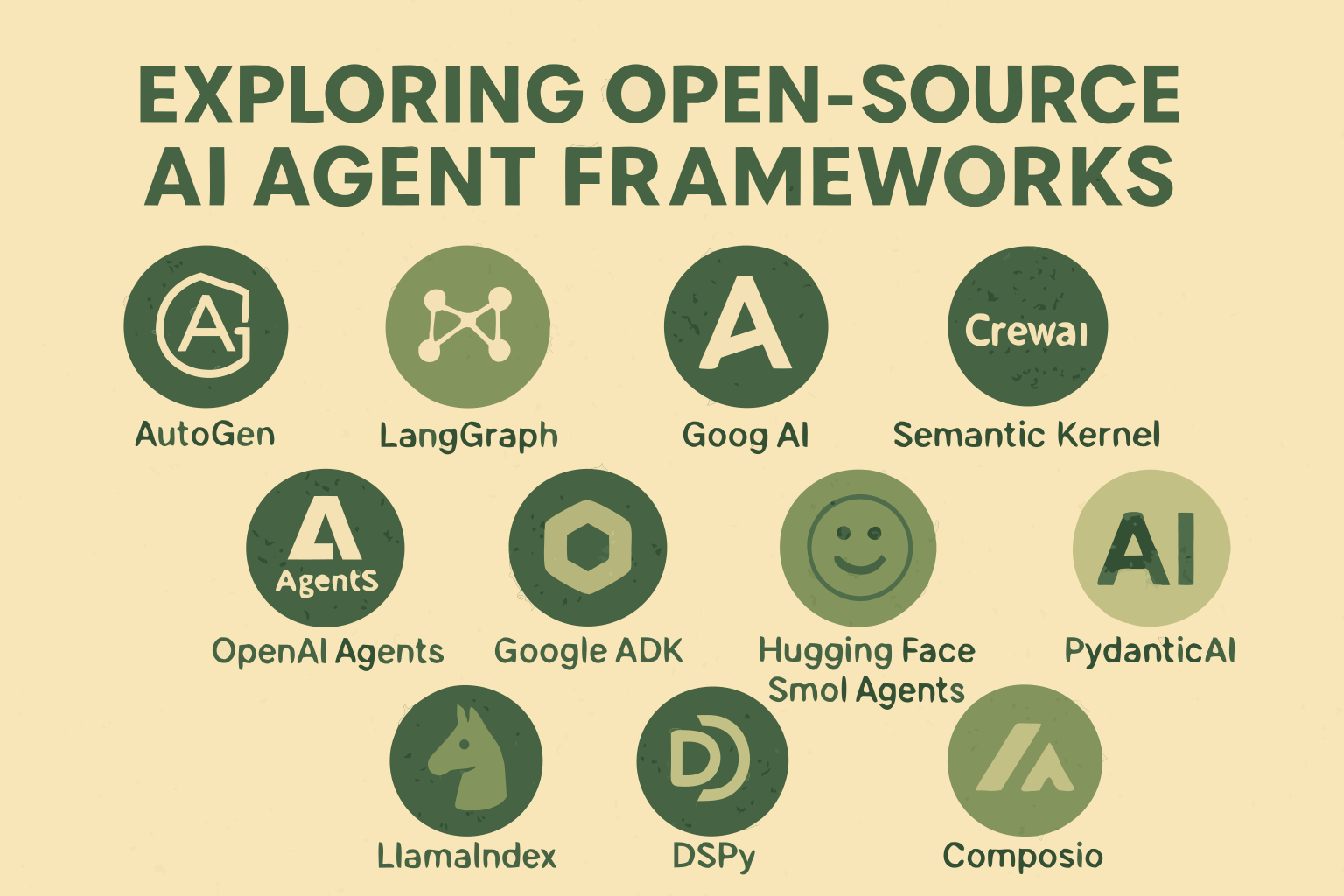
Top 10 Open-Source AI Agent Frameworks of May 2025
AI agent frameworks have exploded in popularity as developers shift from simply calling LLMs to building autonomous systems that can reason, plan, use tools, and even collaborate with other agents. The past year has seen remarkable innovation in this space, with new frameworks emerging to address different aspects of agent development.
Whether you're building a RAG-based assistant, a multi-agent research system, or enterprise AI workflows, finding the right framework is crucial. This guide compares the top open-source AI agent frameworks of 2025, analyzing their architectures, capabilities, and optimal use cases.
What Makes a Great AI Agent Framework?
Modern AI agent frameworks provide the infrastructure for language models to:
- Plan and reason about complex tasks
- Use tools and external APIs (function calling)
- Maintain memory across interactions
- Manage workflows with error handling and retry logic
- Collaborate with other agents in multi-agent systems
- Connect to data sources for retrieval-augmented generation
Let's examine how the top frameworks deliver these capabilities.
The Top 10 AI Agent Frameworks
1. AG2 (formerly AutoGen) - APIpie Integration Guide
Language: Python
Agent Style: Multi-agent conversation framework
Execution Logic: Event-driven, asynchronous
Memory Support: Conversation context, extensible
Tool Use: Flexible, delegated to specialized agents
Notable Features: Multi-agent collaboration, tool integration, code execution
Why it Stands Out: AG2 revolutionizes agent design by framing everything as a conversation among specialized agents. Instead of a single agent loop, you create multiple agents (e.g., an assistant, a user proxy, a coding agent) that communicate asynchronously to solve complex tasks.
With AG2's event-driven architecture, agents can work concurrently rather than sequentially, reducing bottlenecks in multi-step workflows. The framework supports human-in-the-loop workflows for oversight and feedback, allowing for both autonomous operation and human guidance when needed.
AG2 is particularly strong for scenarios involving collaborative problem-solving, like a dialogue between a planning agent and an execution agent, or a research task where different agents contribute specialized knowledge. Its flexible design allows for customizable agent behaviors through system messages and specialized configurations.
GitHub: ag2ai/ag2
2. CrewAI - APIpie Integration Guide
Language: Python
Agent Style: Role-based, collaborative teams
Execution Logic: Dynamic self-organization or scripted flows
Memory Support: Shared crew context, built-in memory modules
Tool Use: Python functions, API integrations
Notable Features: Role-based collaboration, enterprise control plane
Why it Stands Out: CrewAI's greatest strength is its intuitive approach to multi-agent orchestration. By using the metaphor of a "crew" with different roles, it makes complex agent interactions approachable. You can define agents with roles like "Researcher," "Writer," and "Critic," then let them collaborate to solve tasks.
CrewAI offers two modes: self-organizing crews (where agents determine their own collaboration patterns) and explicit CrewAI Flows (where you script exact interactions). This flexibility makes it suitable for both exploratory research and production applications.
With 30,000+ GitHub stars and a growing community of certified developers, CrewAI has become the framework of choice for creative, multi-perspective agent systems.
GitHub: crewAIInc/crewAI
3. LangChain & LangGraph - APIpie Langchain Guide | APIpie LangGraph Guide
Language: Python (JS version available)
Agent Style: Component library (LangChain) + Graph-based agent pathways (LangGraph)
Execution Logic: Chains & callbacks (LangChain), Directed acyclic graph (DAG) (LangGraph)
Memory Support: Multiple memory types, persistent context, checkpoint APIs
Tool Use: Extensive tool library, custom tools, agent executors
Notable Features: Massive ecosystem, visual graph design, checkpointing, deterministic flows
Why it Stands Out: The LangChain ecosystem provides both foundational components (LangChain) and advanced orchestration capabilities (LangGraph). LangChain offers the largest ecosystem of tools, components, and integrations in the LLM space, while LangGraph extends this foundation with graph-based reasoning.
Built on top of LangChain, LangGraph represents agent reasoning steps as nodes in a directed acyclic graph (DAG). This unlocks powerful patterns like parallel processing, conditional branching, and explicit error handling. Its deterministic control flow eliminates randomness in operation order, making debugging and testing more straightforward.
For complex workflows where reliability matters, the LangChain+LangGraph combination stands apart. The framework supports streaming of both final answers and intermediate steps, providing transparency into the agent's thinking process. With the entire LangChain component library available as building blocks, this ecosystem offers unparalleled flexibility.
Companies like Replit, Uber, and Klarna use these frameworks for production applications where certainty, auditability, and access to a rich ecosystem of components are critical.
GitHub: langchain-ai/langgraph | langchain-ai/langchain
4. OpenAI Agents SDK - APIpie Integration Guide
Language: Python
Agent Style: Function-calling, agent handoffs
Execution Logic: Structured workflows, triage patterns
Memory Support: Context management, result storage
Tool Use: Python functions, first-class function calling
Notable Features: Guardrails, agent handoffs, OpenAI integration
Why it Stands Out: As OpenAI's official agent framework, this SDK provides the most seamless integration with GPT-4 and other OpenAI models. It focuses on production readiness with features like guardrails (content filtering, output validation) and standardized patterns for agent-to-agent handoffs.
The SDK emphasizes a lightweight architecture centered on function calling. Instead of complex abstractions, it provides a clean runtime to manage the prompt, function schema, and callbacks, making it accessible to developers already familiar with OpenAI's API.
With nearly 10,000 GitHub stars despite being released only in March 2025, the OpenAI Agents SDK is rapidly becoming the standard for production deployments leveraging OpenAI's models.
GitHub: openai/openai-agents-python
5. Google Agent Development Kit (ADK) - APIpie Integration Guide
Language: Python
Agent Style: Workflow agents, LLM agents
Execution Logic: Sequential, Loop, Parallel agents
Memory Support: State management, persistent agents
Tool Use: OpenAPI specs, Google Cloud tools, MCP
Notable Features: A2A protocol, structured workflows, GCP integration
Why it Stands Out: Google's ADK provides explicit constructs for complex workflow orchestration. With first-class support for Sequential, Loop, and Parallel agents, it offers unparalleled control over multi-step agent processes.
ADK excels at enterprise integration, with built-in support for OpenAPI specifications as tools and secure authentication for accessing external APIs. Its integration with Google Cloud Platform makes it ideal for teams already using GCP services.
As the same toolkit used internally for Google's "Gemini" AI Apps, ADK brings enterprise-grade agent capabilities to open source. Its support for the emerging Model Context Protocol (MCP) and Agent-to-Agent (A2A) protocol positions it well for future interoperability.
GitHub: google/adk-python
6. Microsoft Semantic Kernel (SK) - APIpie Integration Guide
Language: C# and Python (multi-language SDK)
Agent Style: Skills-based, plugin architecture
Execution Logic: Planner with skills orchestration
Memory Support: Rich abstractions (semantic, volatile, persistent)
Tool Use: Native functions, OpenAPI specs, skills
Notable Features: Multi-language support, enterprise integration
Why it Stands Out: Semantic Kernel stands apart with its conventional programming approach to AI agents. Instead of reinventing software architecture, SK treats AI as a natural extension of existing programming paradigms, making it accessible to enterprise developers.
SK's plugin architecture organizes functionality into "Skills" – reusable modules of AI or native functions that can be composed. This encourages clean separation of concerns and reusability across projects. Its planning capabilities can automatically chain these skills to accomplish complex tasks.
With first-class support for C#, Python, and Java, SK caters to enterprise development teams working across multiple languages. Its integration with Azure services makes it particularly attractive for Microsoft-centric organizations.
GitHub: microsoft/semantic-kernel
7. Hugging Face SmolAgents - APIpie Integration Guide
Language: Python
Agent Style: Code-generating reflexive agents
Execution Logic: "Thinking in code" reflexive loop
Memory Support: Limited to model context window
Tool Use: Any Python library via dynamic code
Notable Features: Extreme simplicity (~1000 LOC), code generation, Hub integration
Why it Stands Out: SmolAgents takes a radically different approach to agent design. Instead of complex orchestration, it creates minimal agents that "think in Python code" – literally generating and executing Python snippets to solve problems.
This minimal design (just ~1000 lines of code) offers unparalleled flexibility. The agent can use any Python library by simply importing it in generated code, and security is handled through optional sandboxing via Docker or E2B.
SmolAgents is perfect for rapid prototyping, experimental research, and scenarios where you want the LLM to have maximum freedom in solving problems. Its integration with the Hugging Face Hub allows sharing and reusing agents and tools.
GitHub: huggingface/smolagents
8. LlamaIndex - APIpie Integration Guide
Language: Python
Agent Style: Data-centric, retrieval-augmented
Execution Logic: Query engines, orchestration around data
Memory Support: Vector stores, indices, knowledge graphs
Tool Use: Data connectors, query engines as tools
Notable Features: Best-in-class RAG, multi-modal indexing
Why it Stands Out: LlamaIndex specializes in connecting language models to data. While other frameworks focus on actions and reasoning, LlamaIndex excels at retrieval-augmented generation (RAG) and knowledge access.
Its agent architecture centers on Query Engines that intelligently route questions to appropriate data sources (indices). LlamaIndex provides rich tools for document ingestion, chunking, and indexing, making it the go-to choice for building agents that answer questions from custom data.
With built-in support for various index types (vector, keyword, knowledge graph) and connectors to dozens of data sources, LlamaIndex simplifies what would otherwise be complex data engineering.
GitHub: run-llama/llama_index
9. Pydantic AI - APIpie Integration Guide
Language: Python
Agent Style: Schema-driven, type-safe
Execution Logic: Structured I/O with validation
Memory Support: Custom integration options
Tool Use: Schema-validated function calling
Notable Features: Type safety, multi-model support, Logfire integration
Why it Stands Out: Pydantic AI brings the rigor of type checking to the unpredictable world of LLMs. Created by the team behind Pydantic (used in FastAPI), it enforces output schemas that eliminate many parsing errors and ensure consistent output formats.
This type-safe approach is particularly valuable for production applications where reliability is paramount. By defining strict schemas for agent outputs, Pydantic AI reduces the need for error handling and retry logic.
The framework supports multiple LLM providers (OpenAI, Anthropic, Google, etc.) and integrates with Pydantic Logfire for monitoring, making it a compelling choice for enterprise applications that can't afford unexpected behavior.
GitHub: pydantic/pydantic-ai
10. Agno (formerly Phidata) - APIpie Integration Guide
Language: Python
Agent Style: Lightweight, multimodal
Execution Logic: Efficient chain-of-thought
Memory Support: Long-term storage, vector stores
Tool Use: Python functions, API integrations
Notable Features: Extreme performance, multimodal support, API generation
Why it Stands Out: Agno prioritizes performance and efficiency. While other frameworks might take seconds to instantiate an agent, Agno can do it in microseconds, using 50× less memory than alternatives like LangGraph. This efficiency enables scenarios like running thousands of lightweight agents concurrently.
Beyond performance, Agno stands out for its native multimodal capabilities. It seamlessly handles text, images, and audio in agent tasks without requiring complex integrations. The framework also automatically generates FastAPI routes for agents, simplifying deployment.
For developers who found other frameworks too heavy, Agno offers a compelling alternative that maintains flexibility while dramatically reducing overhead.
GitHub: agno-ai/agno
Honorable Mentions
DSPy (Stanford NLP) - APIpie Integration Guide
Language: Python
Key Feature: Declarative, self-optimizing prompts
Why It's Notable: DSPy treats LLM prompting as a programming discipline, not just string templates. It allows you to decompose agent reasoning into modules and optimize prompts automatically based on examples.
Composio - APIpie Integration Guide
Language: Python, TypeScript
Key Feature: 250+ pre-built tool integrations
Why It's Notable: Not a standalone agent framework, but a powerful complement that provides secure access to hundreds of APIs (Slack, JIRA, Google Docs, etc.) for any agent framework.
PixelTable - APIpie Integration Guide
Language: Python
Key Feature: Declarative multimodal pipelines
Why It's Notable: Combines data infrastructure with agent capabilities, allowing LLMs to make decisions within data processing workflows – ideal for multimodal applications.
Comparing Key Framework Features
| Framework | Multi-Agent | RAG Support | Execution Style | Deployment Options | Best For |
|---|---|---|---|---|---|
| AG2 | ✅ Built-in | 🟡 Via integration | Async, event-driven | Local, cloud | Research, collaborative agents |
| CrewAI | ✅ Core concept | 🟡 Via agent roles | Self-organizing or flows | Self-hosted, control plane | Creative tasks, multi-perspective reasoning |
| LangGraph | ✅ Via graph nodes | ✅ Via LangChain | DAG, deterministic | Server, FastAPI | Complex workflows, auditability |
| OpenAI SDK | ✅ Via handoffs | 🟡 Custom functions | Function calling | Any Python environment | Production OpenAI applications |
| Google ADK | ✅ Agent Teams | ✅ Google Cloud | Sequential, Parallel, Loop | GCP, Cloud Run | Enterprise GCP deployments |
| Semantic Kernel | ✅ Via Skills | ✅ Memory connectors | Planner, Skills | .NET, Python, Java apps | Enterprise Microsoft ecosystem |
| SmolAgents | 🟡 Manual setup | 🟡 Custom code | Code generation | Local, Docker, E2B | Experiments, maximum flexibility |
| LlamaIndex | 🟡 Limited | ✅ Core focus | Query Engines | Backend services | Document Q&A, knowledge bases |
| Pydantic AI | 🟡 Via chaining | 🟡 Custom schema | Type-validated | Python services | Production reliability |
| Agno | ✅ Teams of Agents | ✅ Multimodal | Efficient Chain-of-Thought | FastAPI, Python apps | High-concurrency, performance-critical |
Choosing the Right Framework
For RAG Bots & Document Q&A
- LlamaIndex is the clear choice for sophisticated retrieval from documents, offering specialized indices and query routing
- Semantic Kernel for enterprise knowledge bases with Azure Search integration
- OpenAI Agents SDK paired with retrieval tools for simpler applications
For Multi-Agent Research & Creative Systems
- AG2 for its event-driven, asynchronous multi-agent architecture
- CrewAI for intuitive role-based collaboration and emergent behaviors
- LangGraph when visualization and control over agent interaction is critical
For Production Enterprise Applications
- Google ADK for Google Cloud deployments and structured workflows
- Semantic Kernel for Microsoft ecosystem integration
- OpenAI Agents SDK for production-grade applications using OpenAI models
- Pydantic AI when type safety and validation are paramount
For Performance-Critical Applications
- Agno for minimal overhead and high concurrency
- SmolAgents for maximum flexibility with minimal framework
- Composio to enhance any framework with secure tool integrations
The Future of Agent Frameworks
As we look ahead, several trends are emerging in the agent framework landscape:
- Standardization through protocols like MCP (Model Context Protocol) and A2A (Agent-to-Agent)
- Security improvements with better sandboxing and credential management
- Enterprise features including monitoring, guardrails, and compliance
- Performance optimization for running many lightweight agents
- Observability tools for debugging complex agent behaviors
While no single framework is perfect for all use cases, the diversity of approaches ensures developers can find the right tool for their specific needs. By leveraging these frameworks, developers can focus on building intelligent agents rather than reinventing core infrastructure.
Conclusion
The open-source AI agent ecosystem is thriving in 2025, with frameworks catering to different architectural philosophies and use cases. Whether you need a multi-agent system, robust RAG implementation, or production-grade reliability, there's a framework that fits your requirements.
At APIpie.ai, we're working to provide unified access to the models that power these frameworks, allowing you to focus on building, not managing API integrations. By standardizing access to OpenAI, Anthropic, Google, and other providers, we simplify one crucial aspect of the agent development workflow.
As these frameworks continue to evolve, the barriers to building sophisticated AI agents will continue to fall, empowering developers to create increasingly capable autonomous systems.
Top 5 Open-Source ChatGPT Replacements April 2025
Explore the leading open-source, self-hosted ChatGPT UI alternatives with agent capabilities. Compare LibreChat, AnythingLLM, Open WebUI, LobeChat, and Chatbot UI, plus a list of honourable mentions.
Cursor's 'Does Not Work with Your Current Plan or API Key' Fix
Discover how to bypass Cursor IDE's free tier restrictions & access models like Claude 3.5 Sonnet, GPT-4o, & Gemini Pro with APIpie's unique API key state workaround.